
How to Launch a Solo Project and Get Your First Customers
How to Launch a Solo Project and Get Your First Customers
Most solo founders miss early customers because they launch too wide, wait too long, or try too many channels at once. In your first month, the goal isn't a perfect launch, it's a fast test that shows what people will pay for.
That means picking a clear offer, getting it in front of the right people, and using feedback to adjust quickly. Early traction usually comes from focus and direct outreach, not a polished logo, a fancy site, or a big audience. With that in mind, let's start with how to narrow your offer so people understand it fast.
Start with a small offer people can say yes to
Your first offer should feel easy to understand and easy to buy. In the first month, narrow beats broad because it gives people a clear reason to act. It also makes your outreach sharper, your sales calls shorter, and your feedback far more useful.
A solo project does not need a full product line. It needs one clear promise for one clear type of buyer. When people can quickly see, "This is for me, and it solves a real problem," you remove friction from the sale.
Pick one problem, one customer, and one simple result
The fastest way to shape an offer is to use a basic sentence:
I help [specific customer] solve [specific problem] so they can get [simple result].
That sentence forces focus. It also keeps you from hiding behind features. Early customers do not buy dashboards, templates, or calls. They buy a better outcome, less stress, more leads, saved time, or a faster start.

Keep the offer tight enough that a real person could say yes today. That usually means choosing:
- One customer: freelance designers, local dentists, Shopify store owners, first-time coaches
- One problem: no leads, messy onboarding, weak landing page copy, slow client follow-up
- One result: book more calls, launch in a week, save five hours, get first 10 users
Here are a few simple examples:
- For local service businesses, fix slow lead response so they can book more jobs this month.
- For new coaches, write a one-page offer and landing page so they can start selling this week.
- For busy freelancers, set up a basic client onboarding system so they can save hours every month.
Notice what these do well. They are concrete, short, and outcome-based. They do not say, "I provide consulting solutions." That kind of wording is too foggy to sell.
If your offer feels too wide, use this quick filter. Ask:
- Who is the easiest buyer to reach right now?
- What problem do they already know they have?
- What result can you help them get fast?
That is your starting point. Not your forever offer, just your first one. A narrow offer is like a sharp knife, while a broad offer is a butter knife. One cuts cleanly, the other struggles.
People rarely buy features first. They buy the shortest path to a result they already want.
So instead of listing what is included, lead with what changes for the customer. Features support the sale, but outcomes make the sale possible.
Set a price that feels easy to try
Once the offer is clear, price it so the first yes feels safe. Your goal is not to be cheap. Your goal is to make the decision feel low-risk for the buyer and manageable for you.
That is why entry-level pricing works well early on. You are reducing friction, gathering proof, and learning what people value most. In other words, you are buying speed and feedback, not trying to max out revenue on day one.

A few pricing formats work especially well for a solo launch:
- Pilot offer: A short test version for a small group, often with extra support in exchange for feedback.
- Founder pricing: A lower early rate for the first few customers before you raise prices later.
- First-month package: A clear, time-bound package with one result and one price.
- Starter service: A smaller version of your main offer that solves one urgent piece of the problem.
Here is a simple way to think about it:
| Pricing approach | Best use | Why it works |
|---|---|---|
| Pilot offer | Testing demand | Feels experimental and low-pressure |
| Founder pricing | Getting first case studies | Rewards early action without sounding cheap |
| First-month package | Service-based offers | Keeps the scope clear and the decision simple |
| Starter service | Bigger problem, small first step | Lets buyers try you before a larger commitment |
The takeaway is simple: make the first purchase feel easy, not tiny. There is a difference.
For example, a $99 offer can work if it solves one painful problem fast. A $19 offer may feel cheap, but it can also attract weak-fit buyers who want too much for too little. Low-risk pricing should lower resistance, not lower your standards.
A good early price has three traits:
- It feels reasonable for the result.
- It matches a tight scope.
- It leaves room to raise prices after proof.
You can also reduce risk without dropping the price too far. Try a shorter timeline, a clear deliverable, or a simple promise like a kickoff call plus one finished asset in seven days. People say yes faster when they know exactly what they will get.
A small offer is not a weak offer. It is a focused offer with a smaller commitment.
That is what gets the first customers moving. Once people buy, you learn. Once you learn, you can improve the offer, raise the price, and expand from a much stronger base.
Build a launch page that answers the buyer's main doubts
Your first launch page does not need to be a full website. In most cases, one simple page or even a strong profile page is enough. The job is clear: help a visitor understand the offer fast, trust it enough to care, and know what to do next.
That matters for sales and search. Clear wording helps people, Google, and AI search tools understand your page. So use the same problem-based phrases your buyers use, add proof where it counts, and answer common objections in plain FAQ-style language.
Write copy that says what you do in plain English
Most weak launch pages fail in the first five seconds. The visitor lands, reads vague copy, and leaves. So lead with a headline that says what you do, for who, and what result they get.
A simple formula works well: I help [who] get [result] without [pain]. Then support it with one short line that explains the offer. Skip clever taglines. They sound nice, but they rarely sell.
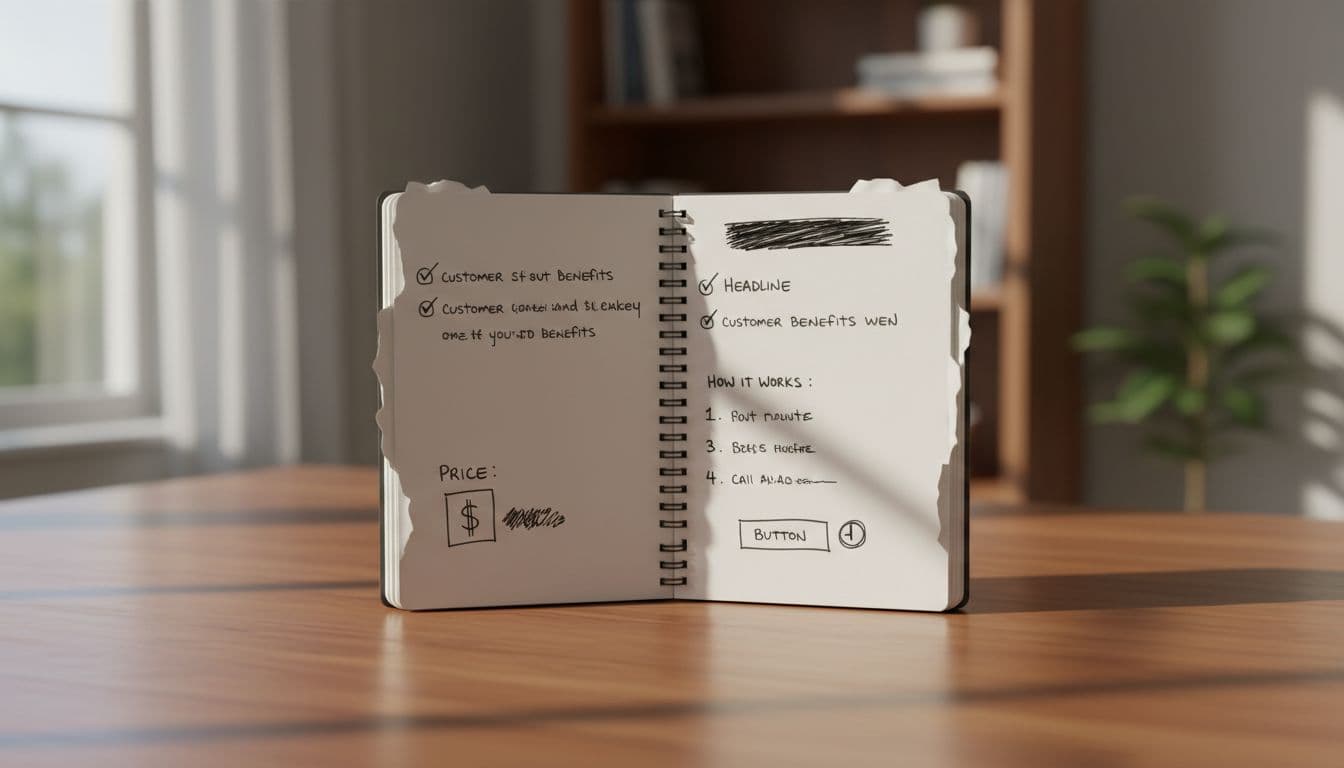
Your page should answer the buyer's main doubts in a simple order. That way, they don't have to hunt for basic facts.
- What is this? Name the offer clearly.
- Who is it for? Call out the right buyer.
- What do I get? List the outcome first, then the deliverables.
- How does it work? Show the steps in plain language.
- How much is it? Put the price or starting price on the page.
- Why should I trust you? Add proof right near the claim.
- What's the next step? Use one clear call to action.
For example, instead of saying, "Conversion-focused strategic support for modern brands," say, "Landing page copy for solo founders who need their first customers." One line tells the reader more than a paragraph of fluff.
Keep the wording simple all the way down the page. Use direct benefits like book more calls, launch faster, save five hours, or get your first paying users. Then make the process feel safe. A short section like "Send your details, get a draft in 3 days, review once, publish" removes friction fast.
Price also matters because hidden pricing creates doubt. If you can't list an exact number, use a clear starting price or package range. Then add a button that tells people what happens next, such as Book a call, Apply now, or Get the starter package.
Finally, add a short FAQ using the same words buyers type into search. Phrases like how long does it take, is this for new businesses, or what do I need before we start help both SEO and AI search systems connect your page to real intent. Simple copy is easier to rank, easier to trust, and easier to buy from.
Add trust fast, even if you're brand new
A new project does not need fake polish. It needs honest proof. Buyers can spot hype quickly, and early trust usually comes from showing real work, real thinking, and real results from anything related.
If you do not have customer wins for this exact offer yet, use nearby proof. That might include past freelance work, a personal story, screenshots from a test project, before-and-after samples, or a mini case study from related experience. The key is to connect the dots for the reader.

A few proof types work especially well on a first-month launch page:
- Past work samples: Show something similar you have already done.
- Mini case studies: Share the problem, what you changed, and the result.
- Testimonials from related work: A strong quote about reliability or skill still helps.
- Screenshots: Show evidence, not claims, as long as private details are hidden.
- Your process: A clear step-by-step method reduces risk because buyers can see how you work.
For instance, if you are offering landing page help, you might show one rewritten section, explain why it is stronger, and include the result from a past client or your own project. That is much more persuasive than saying you are "passionate about helping founders grow."
Honest proof beats big promises every time.
Your personal story can also help if it explains why you built the offer. Keep it short and useful. Maybe you struggled with the same problem, fixed it for yourself, and now offer that fix to others. That gives context, and context builds trust.
Also, make the page feel grounded. Add your name, a real photo if it fits, a short bio, and one clear way to contact you. If the page feels anonymous, people hesitate. If it feels human, they stay longer.
To support search visibility, use proof near the exact claims you want to rank for. If you say you help founders launch faster, place a result, quote, or example right there. Search systems look for clear topic signals, and buyers do too. The page does not need more hype. It needs enough truth to make the next click feel safe.
Get your first customers through direct, low-cost outreach
In month one, direct outreach usually beats waiting for organic traffic. Search can help later, but it takes time. Right now, you need conversations, feedback, and a few real chances to sell.
That is why this stage works best with a small number of channels. Pick the places where buyers already know you, recognize your name, or share the problem you solve. A short list and a clear message will do more than posting everywhere and hoping someone finds you.
Make a short list of warm leads and likely buyers
Start with the people closest to your work. Warm outreach works first because trust already exists, even if it is light. You are not starting from zero, and that matters when you need your first customers fast.
Make one simple list of people and groups who may be a fit. Good places to pull from include:
- Friends and peers who know your skills and may refer you
- Past coworkers who now work with your target buyers
- Old clients who may need help again or know someone who does
- Email contacts from past work, newsletters, or inquiries
- LinkedIn connections in the niche you want to serve
- Communities and niche groups where your buyer already spends time
Then sort that list by fit, not by who feels easiest to message. A strong lead usually has three signs: they match your offer, they likely feel the problem now, and they can say yes without a long process.
A simple way to rank them is to use three buckets:
- Best fit now: clear match, clear need, easy to contact
- Possible fit: right type of buyer, but timing is less clear
- Long shot: weak match, low urgency, or no warm link
Focus your first outreach on the first bucket. That keeps your message sharp and your time well spent. It also gives you faster feedback, which helps you improve your pitch before you move to colder leads.
Warm outreach should come first for another reason. It teaches you what people respond to. You learn which problem statement lands, which offer sounds too broad, and what objections show up early. In other words, your first list is not just a sales list, it is a learning tool.
If you are in a niche group, be careful not to pitch the whole room. First, notice who is already talking about the problem you solve. Then reach out one to one, or join the discussion in a helpful way before you message. People respond better when your outreach feels relevant, not dropped from the sky.
Your first customers often come from people who are one step away, not from strangers who found you by chance.
Send simple messages that start real conversations
Once you have a short list, send plain messages that feel human. The goal is not to close the sale in one note. The goal is to start a real conversation with someone who may already be a fit.
Keep your message short and built around five parts:
- Personal note: show why you picked them
- Problem: name the issue you help with
- Simple offer: explain what you do in one clear line
- Reason now: give a light reason for reaching out today
- Easy next step: ask for a small reply, not a big commitment
Here is the basic shape:
Hey [Name], I saw [specific detail]. I help [type of buyer] fix [problem] so they can [result]. I just started offering a focused version of this, and I thought of you because [reason]. If it is useful, I can send a quick idea or we can do a short call next week.
That works because it sounds like a person, not a blast email. It also keeps the ask light. Instead of pushing for a sale, you invite the next step.
Avoid spammy phrases like just checking in, circle back, amazing opportunity, or scale fast. They sound generic, and generic outreach gets ignored. Write the way you would talk to one smart person you respect. Be direct, calm, and specific.
Also, don't pile on every feature. Lead with one problem and one result. For example, if your offer helps service businesses reply to leads faster, say that. Don't also mention funnels, automation, content, analytics, and consulting. Too much detail blurs the point.
If someone does not reply, follow up once or twice with space in between. A simple rhythm works well:
- First message
- Follow-up 3 to 5 days later
- Final follow-up about a week after that
Each follow-up should add a small reason to reply. You might share one idea, point out a relevant issue, or restate the offer in a clearer way. Keep it short. A follow-up is a nudge, not a new sales page.
For example, a second note could say that you had one quick idea after looking at their site or process. A final note can simply close the loop and leave the door open. That keeps your outreach respectful, which matters if your niche is small.
Most importantly, track what happens. Notice which messages get replies, which buyer types respond fastest, and which problem statements fall flat. After ten or twenty messages, patterns show up. Then your outreach stops feeling like guesswork and starts working like a simple system.
Direct outreach is not flashy, but early on it is often the shortest path to revenue. While organic traffic builds slowly in the background, personal contact can put your offer in front of the right people this week.
Good Luck! Check out the feature on our website to get a sense of how we started from one simple resume analyzer and turned into a site with over 10,000 monthly users! ###https://JobWiz.org
Discussion(0)
Sign in to join the discussion.
Share your thoughts and interact with the community.